
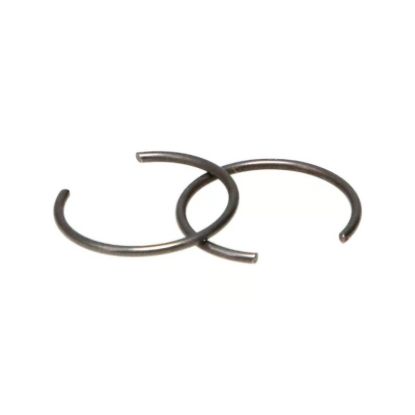
Piston Clips
Are new pistons going into your engine, or do the old wrist pin locks need replacing? The locks hold the wrist pin in place in the piston so it doesn't walk out and score the cylinder wall. We stock wire locks and Tru-Arc locks in several sizes for your engine project.
What wrist pin locks do
The wrist pin connects the piston to the connecting rod and, in many designs, can move in the piston's pin bore. The locks sit in a groove at each end of the bore and prevent the pin from sliding sideways out towards the cylinder wall. In this category you'll find, for example, wire locks from JE Pistons and CP Pistons as well as Tru-Arc locks from JE Pistons, and brands such as Mahle, Supertech and Wiseco are also represented. You'll find the pins themselves under wrist pins, and the pistons under pistons.
How to choose the right lock
The lock must match your specific piston, and the correct size depends on the piston's groove, not just the pin diameter. So check:
- Type: wire lock or Tru-Arc – the piston groove is typically designed for one specific type.
- Bore size and pin diameter: for example, some CP locks are specified by bore size (.905 in) and pin diameter (23 mm or 21 mm).
- Wire thickness: for example .073 in, which must match the width of the groove.
As a rule, use new locks every time you assemble, as a lock can lose tension or become deformed when removed. Make sure the lock is fully seated in the groove all the way around and that the gap is positioned as the piston manufacturer specifies. If you buy complete piston sets, locks may already be included – check the contents for the specific part number. If the engine is also getting new piston rings, it makes sense to replace both at the same time.
Frequently asked questions
What is the difference between a wire lock and a Tru-Arc lock?
A wire lock is a bent wire that springs out into the piston groove, while a Tru-Arc lock is a flat retaining ring. Which type you need depends on the groove design of your piston – they typically cannot be interchanged.
Can I reuse the old locks?
This is generally not recommended. The locks can lose tension or become deformed when removed, and a lock that pops out during operation can seriously damage the cylinder wall. New locks at every assembly are the safe solution.
How do I find the right size for my pistons?
Check the piston manufacturer's specifications for your specific piston: lock type, pin diameter, bore size and wire thickness. Product names often state the dimensions, for example bore size in inches and a thickness of .073 in. Always compare with the piston's part number.


JE Pistons .827 X .050 0.6GR Wire Lock
jep827-050-MW
JE Pistons .827 X .050 0.6GR Wire Lock
8,06 € excl. VAT

